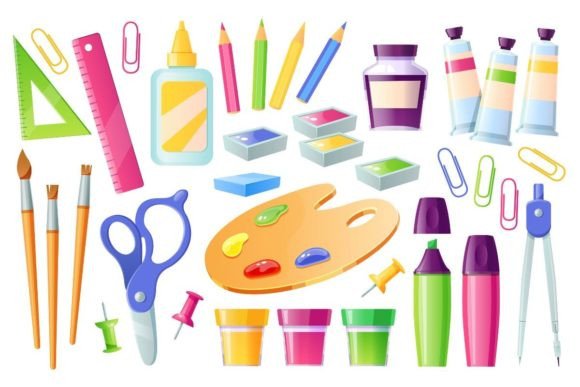
The Essential Role of School Supplies and Stationery in Creative Development
In the modern educational and creative landscape, the tools we use are often as significant as the ideas they help to manifest. While digital platforms have revolutionized how information is consumed, the tactile experience of working with physical School Supplies and Stationery remains irreplaceable for fostering fine motor skills, spatial reasoning, and artistic expression. From the humble paper clip to the precision of a compass, these items form the backbone of learning environments worldwide. Whether you are an educator organizing a classroom, a parent preparing for the academic year, or a professional designer sourcing inspiration, understanding the depth and utility of these materials is crucial.
The Foundation of Tactile Learning
At the heart of any effective learning environment lies a curated selection of essential tools. These are not merely objects stored in a drawer; they are instruments of discovery. When we discuss School Supplies and Stationery, we are referring to a diverse ecosystem of products that facilitate both structured academic work and unstructured creative exploration. The interaction between hand and tool provides sensory feedback that screens simply cannot replicate. This haptic engagement is vital for cognitive development, particularly in younger learners who are establishing neural pathways associated with writing, drawing, and manipulating objects.
Consider the simple act of using a ruler and scissors. These items teach precision and planning. A student must measure before cutting, understand the concept of straight lines versus curves, and execute a physical action that requires coordination. Similarly, the use of a compass introduces geometry in a tangible way, allowing learners to visualize circles and arcs rather than just reading about them on a page. These fundamental interactions build the confidence necessary to tackle more complex problems later in life.
Core Tools for Precision and Structure
- Ruler: Essential for measuring length, drawing straight lines, and ensuring alignment in diagrams and charts.
- Scissors: Critical for cutting, shaping, and crafting, developing dexterity and control.
- Compass: A specialized tool for drawing perfect circles and arcs, fundamental for geometry and technical drawing.
- Paper Clips or Pins: Small but mighty organizational aids that keep documents secure and projects intact.
These items represent the structural side of stationery. They provide the framework within which creativity can operate safely and effectively. Without a ruler, a blueprint is guesswork; without scissors, a collage is impossible. In professional settings, such as architecture or engineering, the principles learned with these basic tools translate directly into CAD software usage and physical prototyping. The transition from analog to digital is smoother when the foundational concepts are mastered through hands-on practice with traditional School Supplies and Stationery.
Unleashing Creativity Through Color and Texture
While structure provides the skeleton, color and texture provide the flesh and blood of creative projects. The artistic side of stationery encompasses a wide array of materials designed to stimulate imagination. Colored pencils, paints, brushes, markers, and palettes are not just for art class; they are powerful communication tools used across disciplines. In marketing, color psychology dictates brand perception. In education, visual aids created with these tools can make abstract concepts concrete and memorable.
The choice of medium significantly impacts the outcome of a project. Colored pencils offer control and layering capabilities, ideal for detailed illustrations and shading. Paints and brushes introduce fluidity and blending, encouraging experimentation with color theory and texture. Markers provide bold, vibrant strokes that are excellent for highlighting key points or creating high-contrast graphics. Each medium has its own characteristics and advantages, making the selection process a critical part of the creative workflow.
Key Artistic Materials and Their Applications
- Colored Pencils: Perfect for detailed work, sketching, and adding subtle gradients to illustrations.
- Paints and Brushes: Ideal for large-scale projects, mixing colors, and exploring different textures and finishes.
- Markers: Best for bold outlines, graphic design elements, and quick annotations.
- Palette: An indispensable surface for mixing custom colors, ensuring consistency, and managing paint flow.
When integrating these materials into a curriculum or a personal project, it is important to consider the specific goals. For instance, a lesson on light and shadow might benefit most from colored pencils, while a unit on emotions could be better served by the expressive potential of watercolors. Educators and creators alike should encourage the exploration of various mediums to find what resonates best with their audience or students. The versatility of School Supplies and Stationery ensures that there is always a tool suited to the task at hand.
The Digital Bridge: Vector Illustrations and File Formats
In today's hybrid world, the line between physical stationery and digital assets is increasingly blurred. Many modern educational resources and creative projects begin with a physical sketch or illustration before being digitized. This is where the concept of Cartoon vector illustration becomes relevant. Vector graphics are scalable images that maintain their quality regardless of size, making them perfect for everything from business cards to billboards. They are often derived from hand-drawn concepts that originate with the very School Supplies and Stationery discussed earlier.
For professionals and educators looking to share their work, understanding file formats is essential. A typical set of digital assets derived from physical inspiration might include specific formats tailored for different uses. For example, a vector EPS file is industry-standard for print production and further editing in professional software like Adobe Illustrator. It preserves the mathematical paths of the illustration, allowing for infinite scaling without pixelation. Conversely, a JPG image file is optimized for web use, email distribution, and general viewing, offering a balance between quality and file size.
This dual-format approach ensures maximum flexibility. A teacher might create a colorful cartoon illustration using markers and paints, scan it, convert it to a vector EPS for printing on worksheets, and then save a JPG version to upload to a learning management system. Similarly, a business owner might use a hand-sketched logo concept, refined with a compass and ruler, and convert it into a vector format for branding materials. The journey from physical tool to digital asset demonstrates the enduring relevance of traditional stationery in a digital age.
Benefits of Hybrid Workflows
- Enhanced Creativity: Starting with physical media allows for spontaneous, organic creation that can be difficult to achieve immediately on a screen.
- Versatility: Converting physical sketches to vector files enables use across multiple platforms, from print to web.
- Professional Quality: High-resolution vector files ensure that designs look crisp and professional in any context.
- Educational Value: Students learn the full lifecycle of a design project, from concept to execution to digital delivery.
The integration of these digital considerations into the broader conversation about School Supplies and Stationery highlights the adaptability of these tools. They are not relics of the past but active participants in the modern creative economy. By understanding how physical tools translate into digital formats, users can maximize the value of their resources and reach wider audiences.
Organizational Strategies for Efficiency
Beyond the creative and educational aspects, the organization of supplies plays a pivotal role in productivity. A chaotic workspace can stifle creativity and hinder learning. Effective organization involves more than just having a desk; it requires a strategic approach to storing and accessing glue, rulers, scissors, and other essentials. This applies equally to a busy classroom, a home office, or a professional studio.
One effective strategy is categorization by function. Grouping items based on their primary use—such as cutting tools, writing instruments, and adhesive materials—can streamline workflows. For instance, keeping all cutting tools (scissors, craft knives) in one designated area reduces the time spent searching for the right tool and minimizes safety risks. Similarly, storing writing implements together ensures that a writer or artist can quickly switch between pens, pencils, and markers without interruption.
Another consideration is the scale of storage. Small items like paper clips or pins can easily get lost if not properly contained. Using small containers, magnetic strips, or compartmentalized trays can keep these tiny but essential items accessible. For larger items like paint sets or brush collections, dedicated drawers or shelves prevent clutter and protect delicate tools from damage. The goal is to create an environment where the tools support the work rather than becoming obstacles.
Practical Tips for Maintaining Order
- Label Clearly: Use labels on bins and drawers to indicate contents, making it easy for everyone to find and return items.
- Regular Audits: Periodically check supplies to restock low items and discard broken or dried-out materials.
- Designated Zones: Create specific areas for different activities, such as a "cutting zone" or a "painting station," to contain mess and improve focus.
- Accessibility: Ensure that frequently used items are within easy reach, while less common tools are stored slightly further away.
By implementing these organizational strategies, individuals and institutions can enhance efficiency and reduce stress. A well-organized space encourages a mindset of readiness and professionalism. Whether you are managing a team of designers or guiding a classroom of students, the way you handle your School Supplies and Stationery reflects your commitment to excellence and order.
Future Trends in Educational and Creative Tools
As we look toward the future, the evolution of School Supplies and Stationery continues to be driven by innovation and sustainability. There is a growing demand for eco-friendly materials, such as biodegradable glues, recycled paper, and non-toxic paints. These developments reflect a broader societal shift towards environmental responsibility and health-conscious choices. Educators and consumers are increasingly prioritizing products that minimize waste and reduce exposure to harmful chemicals.
Furthermore, the integration of technology with traditional tools is expanding. Smart notebooks that sync with tablets, erasable pens that connect to apps, and augmented reality overlays for textbooks are just a few examples of how the boundaries are blurring. However, despite these advancements, the core appeal of physical stationery remains strong. The satisfaction of holding a pencil, the smell of fresh paper, and the unpredictability of paint mixing continue to offer unique experiences that digital alternatives struggle to replicate.
Ultimately, the future of School Supplies and Stationery lies in a balanced approach that leverages the best of both worlds. By embracing sustainable practices and technological enhancements while preserving the tactile joy of traditional tools, we can create richer, more engaging learning and creative environments. Whether you are a researcher studying the impact of tactile learning, a hobbyist exploring new mediums, or a business owner optimizing your supply chain, the story of stationery is far from over. It is a dynamic narrative of human ingenuity, adaptation, and the enduring power of simple tools to shape our world.